
GPUStack Security Review After November 2026 Unauthenticated Admin Access Exploit
In short
GPUStack faced a critical unauthenticated admin access flaw in versions before 2.2.0. This review details the exploit, fixes, and current status as of November 2026.
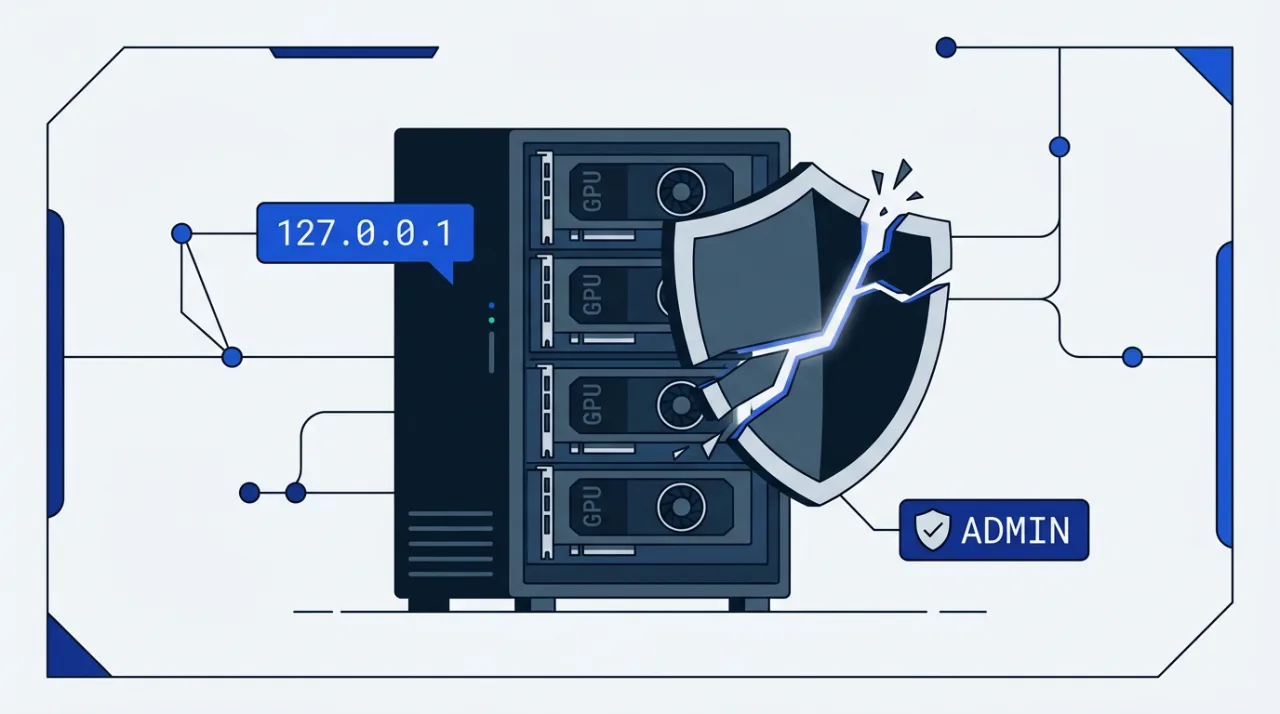
GPUStack security review focuses on CVE-2026-102895, a critical vulnerability that exposed full administrative control to remote attackers without credentials. The issue affected deployments running versions earlier than 2.2.0 and was confirmed exploited in the wild by early November 2026. Users evaluating whether GPUStack is safe must consider both the resolved flaws and the need for immediate upgrades.
GPUStack Vulnerability and Attack Vectors
The core flaw resided in the get_current_user function within gpustack/api/auth.py. When force_auth_localhost remained at its default false setting, the system trusted any request appearing to originate from 127.0.0.1 as the built-in administrator. Attackers bypassed authentication through two main paths: same-host reverse proxies that forwarded external traffic as loopback connections and forged X-GPUStack-Real-IP headers in embedded gateway mode.
Once inside, an attacker gained unrestricted access to enumerate and modify users, models, workers, and configuration settings. They could generate persistent admin API keys with full scope, disclose worker and cloud secrets, and achieve remote code execution by posting malicious YAML to the inference-backends endpoint. Observed incidents included reverse shells deployed on worker nodes running version 2.1.1.
The vulnerability carried a CVSS score of 9.8. Exploitation was reported against a production 2.1.1 instance around November 5, 2026, prompting CISA-ADP to mark it as actively exploited by November 9. No public proof-of-concept code had appeared in major indexes at that time, though the EPSS score sat near 0.3 percent.
Fix Timeline and Related Issues
Developers merged the corrective commit in May 2026, and version 2.2.0 shipped on June 18, 2026. That release eliminated the automatic loopback administrator trust and hardened IP address handling. The GitHub Security Advisory GHSA-gj9m-f8ph-pmhr followed on July 31, with the CVE published publicly on November 4, 2026.
Additional disclosures on the same date included CVE-2026-102894, a SAML callback signature bypass affecting versions from 0.7.1 onward and fixed in 2.2.2. CVE-2026-103002, rated 8.8, involved missing authorization on the cluster proxy and impacted the 2.2.0 through 2.2.2 range. An earlier issue, CVE-2026-58658, had exposed worker endpoints and was resolved after 2.2.1.
By November 9, 2026, the current release stood at 2.3.0, released October 23. All versions from 2.2.2 onward address the identified cluster of authentication and authorization problems.
| CVE | CVSS | Affected Versions | Fixed In |
|---|---|---|---|
| CVE-2026-102895 | 9.8 | < 2.2.0 | 2.2.0 |
| CVE-2026-102894 | 9.1 | >= 0.7.1 | 2.2.2 |
| CVE-2026-103002 | 8.8 | 2.2.0–2.2.2 | 2.2.3 |
| CVE-2026-58658 | Not rated | < 2.2.1 | 2.2.2 |
Practical Mitigation Steps
Operators should upgrade to 2.2.2 or later without delay and recreate all containers from the updated images. Existing administrator API keys must be revoked and replaced after the upgrade. For any remaining older deployments, set force_auth_localhost to true, configure reverse proxies to strip the X-GPUStack-Real-IP header, and restrict API endpoints to trusted networks only.
Regular monitoring of release notes and security advisories remains essential, as further issues may surface. GPUStack user reviews and complaints have centered on timely patching rather than ongoing exploitation reports after the November disclosures.
- Verify current version with the CLI command gpustack --version
- Update via pip install --upgrade gpustack or the official Docker image
- Review and rotate all API keys post-upgrade
- Test authentication enforcement after changes
Frequently asked questions
Is GPUStack safe after the November 2026 exploit?
Deployments running 2.2.2 or newer address the reported authentication bypass. Operators who apply the update and rotate keys restore the intended security posture.
What versions of GPUStack contain the admin access flaw?
Versions before 2.2.0 allowed unauthenticated remote requests to gain full administrative rights through the loopback trust mechanism.
How can users mitigate the GPUStack vulnerability without upgrading?
Setting force_auth_localhost to true, stripping the X-GPUStack-Real-IP header at any proxy layer, and restricting network access to the API provide temporary controls.
Were other CVEs disclosed alongside CVE-2026-102895?
Yes, CVE-2026-102894 and CVE-2026-103002 were published on the same date and affect overlapping version ranges, each addressed in subsequent 2.2.x releases.
TrustScope
Comments 1